Tag: life

  • When War Meets Humanity: A Baby Left Behind

    👶 A Newborn at the Door: Humanity Amid the War in Khartoum

    When the war broke out in Khartoum, someone told this story:

    “My friends and I decided to stay home and not leave. One day, as the shelling grew heavier, we heard loud banging on the door.
    We were surviving. Barely.
    And then — the knock.
    When we opened it, two soldiers were standing there. They handed me a bundle and quickly walked away.

    We unwrapped it — and to our shock, inside was a newborn baby.
    We don’t know where they found him, and we don’t know why they chose our house.”

    What does it mean — to save a life when hundreds are dying? 💔

    I kept reflecting on that moment. Two soldiers, in the midst of relentless bombardment and daily death, left a newborn at the door of strangers.

    This single act revealed something profound: the resilience of human empathy, even in the harshest conditions that strip people of their humanity.

    It was the raw instinct to protect the vulnerable. 🕊️

    We are biologically wired to respond to infant cues. They have signals that activate caregiving circuits in the brain. Even in war, this system does not switch off. In fact, it may grow stronger.

    Seeing a newborn likely triggered an automatic, primal urge in those soldiers to protect life amid surrounding death.

    War often forces soldiers into moral disengagement — psychological mechanisms that justify violence and detach them from empathy. But facing a helpless infant can spark moral re-engagement.

    A baby carries no political, ethnic, or military identity. A baby embodies pure vulnerability. For a moment, it forces recognition of shared humanity — a crack in the logic of dehumanization that war demands.

    And in the chaos of death and destruction, humans search for meaning. Even the smallest act of preservation can be a psychological anchor. Saving that child may have been the soldiers’ way of saying:

    “Not everything is lost. Not everything is meaningless.”

    It was an act of defiance against the absurdity of war — a way to reclaim both agency and humanity.

    The young man who told the story added:

    “We were just a group of young people. We had no idea how to care for a baby. Fortunately, our grandmother was with us — the only elder who had stayed behind. She knew exactly what to do: feeding, cleaning, caring.

    But the dilemma remained: how could we keep him here, with the shelling, shortages, and constant danger? We posted about it on social media. A family preparing to leave the area with their children came and took him with them.”

    Later he wondered: Why our home? Why us?

    Maybe they saw our lights on. Maybe they remembered this street from before. Maybe it was pure chance — the only house with a door still hanging straight.

    Maybe the choice was not random after all. The soldiers may have sensed something — a house that felt safe, civilian, human. Perhaps a fleeting memory, perhaps intuition.

    They didn’t have time to find a hospital. Didn’t have time to find family. Didn’t have time to be heroes. So they did the next best thing — they trusted strangers. 🤲

    While “fight or flight” is the well-known survival response, under collective threat humans also activate “tend and befriend” — the drive to protect the vulnerable and seek social bonds as a survival strategy. Leaving the baby with civilians was an act of social trust: the implicit belief that “someone will care for this child.”

    A newborn represents the future — continuity, renewal, hope. 🌱 Amid scenes of death, preserving a baby is an unconscious affirmation of life itself. Psychologically, it is a defense against existential despair.

    “If this child lives, maybe we haven’t lost everything.”

    Sara

    If you’re reading this — you’re part of that rebellion too. ✨
    Pass it on. Protect someone. Choose life.
    Even when it’s hard. Especially when it’s hard. ❤️

  • Feeling Guilty for Not Feeling Guilty: Lessons from Lockdown

    Feeling Guilty for Not Feeling Guilty: Lessons from Lockdown

    Survivor’s Guilt: Thriving in Crisis

    January 2020. COVID-19 was gathering its full force, preparing to strike the world like nothing we had seen before.

    At the time, I was working a full-time job—physically and mentally demanding—while quietly battling a number of scattered health issues. What I really needed, more than anything, was rest. Deep rest. A pause. A chance to breathe, reflect, and heal.

    And then, as if on cue, the world changed.

    Every news channel, every screen, every conversation became consumed by the pandemic. Uncertainty and fear spread as fast as the virus itself. Governments scrambled to respond to an unprecedented crisis. People were scared—of the unknown, of getting sick, of losing loved ones, of losing their livelihoods. You saw it all. The anxiety was everywhere.

    Then came the lockdown. 🚪

    Overnight, everything stopped.

    To most of the world, it felt like a crisis.
    To me? It felt like a gift from God. ✨

    My 40 hours of in-person work each month shrank to just four hours online. No commuting. No errands. No social obligations. Just home. Just silence. Just time.

    For the first time in months—maybe years—I had space. My body began to recover. My mind slowed down. I slept better. I breathed deeper. I was, honestly… happy. 😌

    While the world grieved, I was at peace.
    I was thankful. Even joyful.
    And that joy came with a quiet shadow: guilt.

    People around the globe were suffering—getting sick, losing jobs, losing family members, stranded across borders. Lives were unraveling.
    And here I was… grateful. At peace. Healing.

    So I asked myself: Shouldn’t I be sad? Shouldn’t I feel more empathy?

    🧩 The Psychology of Feeling Guilty for Not Feeling Guilty

    What I was experiencing was a subtle form of survivor’s guilt—not because I survived a tragedy while others didn’t, but because I thrived in circumstances that crushed so many.

    Survivor’s guilt isn’t limited to war zones or natural disasters. It shows up in quieter ways:

    • The person displaced by conflict who finds safety and opportunity abroad 🌍
    • The business owner whose services suddenly become essential during a crisis 💼
    • The freelancer who flourishes during an economic collapse while others lose everything 💻

    Sometimes, in the middle of a global storm, one person finds shelter. That doesn’t mean they’re ignoring the rain—it just means they’re finally dry. ☔

    When we feel okay—even good—during a collective crisis, our minds often rebel. On one side: gratitude for the unexpected relief. On the other: a quiet, insistent voice whispering, How can you feel this way when others are suffering?

    This is what psychologists call meta-emotion—an emotion about your own emotions. In my case, it wasn’t just happiness I was feeling. It was guilt about being happy.

    A loop formed:
    You’re not sad. You should be sad. Therefore, you’re failing.
    As if our emotional states must always mirror the global mood.

    But here’s the truth: emotions are not moral judgments.

    💡 What Was Really Happening Inside Me

    🧠 Cognitive Dissonance
    My internal reality—relief, rest, recovery—clashed with the external one: a global tragedy. My brain struggled to reconcile the contradiction: How can I feel good when the world feels bad?
    The easiest resolution? Guilt. My mind punished me for not following the expected emotional script.

    🧠 Social Norms and Emotional Expectations
    Society assumes that during collective trauma, everyone should feel sorrow, anxiety, or grief. When we don’t, we feel like we’re failing a moral test. But emotions aren’t moral choices. They’re responses to personal context.

    🧠 The Gift of Reduced Allostatic Load
    For people with chronic stress or health issues, the lockdown wasn’t just a disruption—it was a decompression:
    • Less commuting = lower cortisol 🚗
    • Fewer social demands = reduced cognitive load 🗓️
    • More sleep = better immune function 😴

    The pandemic was a tragedy.
    But for some of us, it was also a rare moment of stillness—of breath, of recovery, of unexpected grace. 🌱

    By the end of the year, my health was better than it has ever been. 💪

    Because healing doesn’t have to wait for permission.
    And peace doesn’t have to apologize for existing—
    even in the middle of a storm. ⛈️

    And that doesn’t make us bad.
    It makes us human. ❤️

    — Sara


    💬 Did you feel something similar during the pandemic—or during another crisis? I’d love to hear your story in the comments. Let’s start a conversation. 🌍✨


  • Facing the Fear of Flying: Personal Insights and Tips

    Facing the Fear of Flying: Personal Insights and Tips

    A single, tragic aviation incident recently hijacked my peace of mind. It wasn’t just another headline—it was a devastating crash minutes after takeoff, claiming dozens of lives in the air and on the ground. I didn’t just read about it. I lived it—every detail, every victim’s story, every grieving family member shared online. I felt their pain like it was mine.

    And suddenly, my old companion—flying anxiety—came roaring back, louder than ever.

    I’ve always had a mild fear of flying. Nothing extreme—just that familiar knot in the stomach during turbulence, the white-knuckle grip on the armrest when the plane hits an air pocket. But over the past year, it’s grown. Sharper. More persistent. The breaking point? A 14-hour nonstop flight with no incidents—no technical issues, no delays, no rough weather. Just me, trapped in my own head, obsessing over every creak of the cabin.

    The flight itself was fine.
    But my mind wasn’t.

    For days after landing, I couldn’t enjoy where I was because all I could think about was the return journey. That dread seeped into my entire trip, robbing me of joy, focus, and presence. And now, after this recent tragedy, it’s worse. My inbox is flooded with news alerts: planes skidding off runways, mid-air collisions, emergency landings, private jets crashing into fields. Big airlines, small charters—nothing feels safe anymore.

    So I started wondering:
    Are plane crashes actually becoming more common?

    Or is it just that we’re hearing about them more?

    Here’s what the data says: commercial aviation is still one of the safest ways to travel. According to the International Air Transport Association (IATA), in 2023 there were only 5 major accidents involving passenger jets worldwide—and just 1 fatal accident. With over 37 million commercial flights that year, that’s an accident rate of less than 0.00001%. Statistically, you’re far more likely to be injured driving to the airport than flying across continents.

    But here’s the catch: our brains don’t care about statistics.

    Anxiety doesn’t listen to logic. It feeds on images, stories, and worst-case scenarios. And thanks to social media algorithms, every time I search for flight updates or watch a documentary about aviation, my feed floods with crash footage, survivor interviews, and dramatic headlines. The internet remembers my fear—and serves it back to me, amplified.

    That’s when I realized: my anxiety wasn’t just about flying.
    It was about loss of control.

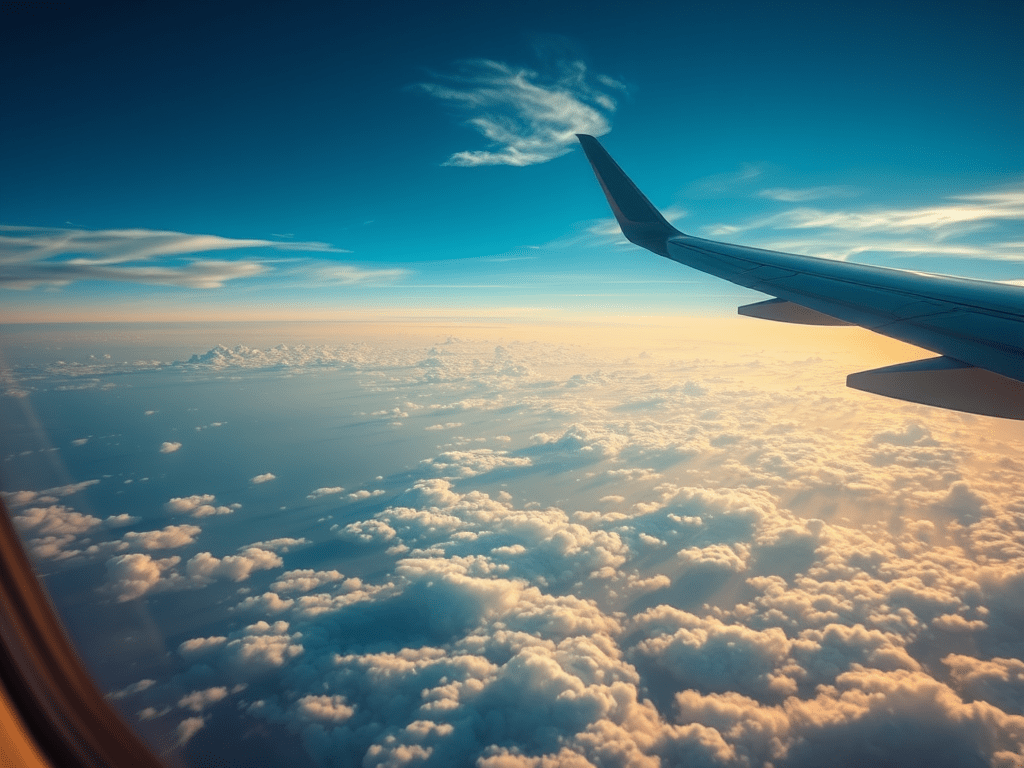
    Sitting in that metal tube, 35,000 feet above the earth, I can’t steer, can’t see the runway, can’t predict the weather. All I can do is surrender. And for someone who likes to plan, to anticipate, to feel prepared—that’s terrifying.

    So I stopped fighting the fear. Instead, I sat with it.

    I asked myself: What exactly am I afraid of?
    Not “crashing.” That’s too vague.
    Is it the noise? The turbulence? The idea of not being able to escape?
    Turns out, it’s the anticipation—the waiting, the imagining, the mental rehearsal of disaster.

    Once I named it, I could work with it.

    Now, when anxiety creeps in weeks before a flight, I don’t push it away. I acknowledge it. Then I replace it.
    I visualize the journey going smoothly. I imagine walking through the terminal calmly, boarding without hesitation, feeling the hum of the engines as a lullaby, not a threat.

    On the plane, I practice gratitude.
    Thank you for this seat. Thank you for skilled pilots. Thank you for safe skies.
    I picture the plane descending gently, touching down softly, rolling to a stop at the gate. If it’s a new destination, I watch videos of the airport, study the layout, imagine myself walking through arrivals, smiling, free.

    And I bring work—drafts, essays, ideas I love to write about. Because when I’m immersed in something meaningful, time flies. Literally.

    This isn’t a magic cure.
    Some flights are still harder than others.
    But I’m no longer letting fear cancel trips, silence opportunities, or steal my peace.

    Because here’s the truth:
    Anxiety wants you to believe danger is everywhere.
    But life? Life happens despite risk—not because it’s perfectly safe.

    And I refuse to miss it just because I’m afraid of the sky.

    If this resonates with you, I’d love to hear your story. Share it with someone who understands—or drop a comment below. You’re not alone.

    Sara